
Ethereum co-founder Vitalik Buterin has set an ambitious goal to scale the network to 100,000 transactions per second (TPS) through a comprehensive rollup-centric roadmap unveiled this week. The announcement, made in a detailed blog post published yesterday, outlines how Ethereum plans to achieve massive scalability improvements while maintaining its core commitment to decentralization and security.
The scaling vision is part of “The Surge,” the next major phase in Ethereum’s development roadmap following the successful Merge to proof-of-stake. Rather than pursuing simple solutions that could compromise the network’s decentralized nature, Buterin’s plan relies on sophisticated Layer 2 (L2) solutions and cross-chain interoperability improvements to create what he describes as a unified ecosystem experience.
The 100,000 TPS Target and “The Surge”
The 100,000 TPS goal represents a massive leap from Ethereum’s current mainnet capacity of roughly 15-30 transactions per second. While existing Layer 2 rollups like Arbitrum and Optimism already provide significant throughput improvements, Buterin’s roadmap envisions coordinated scaling across the entire Ethereum ecosystem to reach five-figure transaction processing capabilities.
This ambitious target addresses one of the most persistent criticisms of Ethereum—its limited throughput compared to newer blockchain networks that claim higher transaction speeds. However, Buterin emphasizes that raw speed alone isn’t the objective. The roadmap prioritizes maintaining Ethereum Layer 1 (L1) as a “robust and decentralized base layer” while using L2 solutions to handle the bulk of transaction processing.
The Surge phase builds on infrastructure improvements delivered through recent upgrades, particularly the Dencun upgrade that introduced blob transactions to reduce data availability costs for rollups. These proto-danksharding capabilities already provide a foundation for more cost-effective L2 scaling, but the roadmap envisions further enhancements to push throughput dramatically higher.
Buterin’s plan acknowledges that achieving 100K TPS requires more than just technical improvements—it demands rethinking how different scaling solutions coordinate and interact. The roadmap includes specific strategies for data compression, optimized gas fee structures, and enhanced interoperability between different L2 platforms.
Technical Approach: Why Layer 2 Rollups?
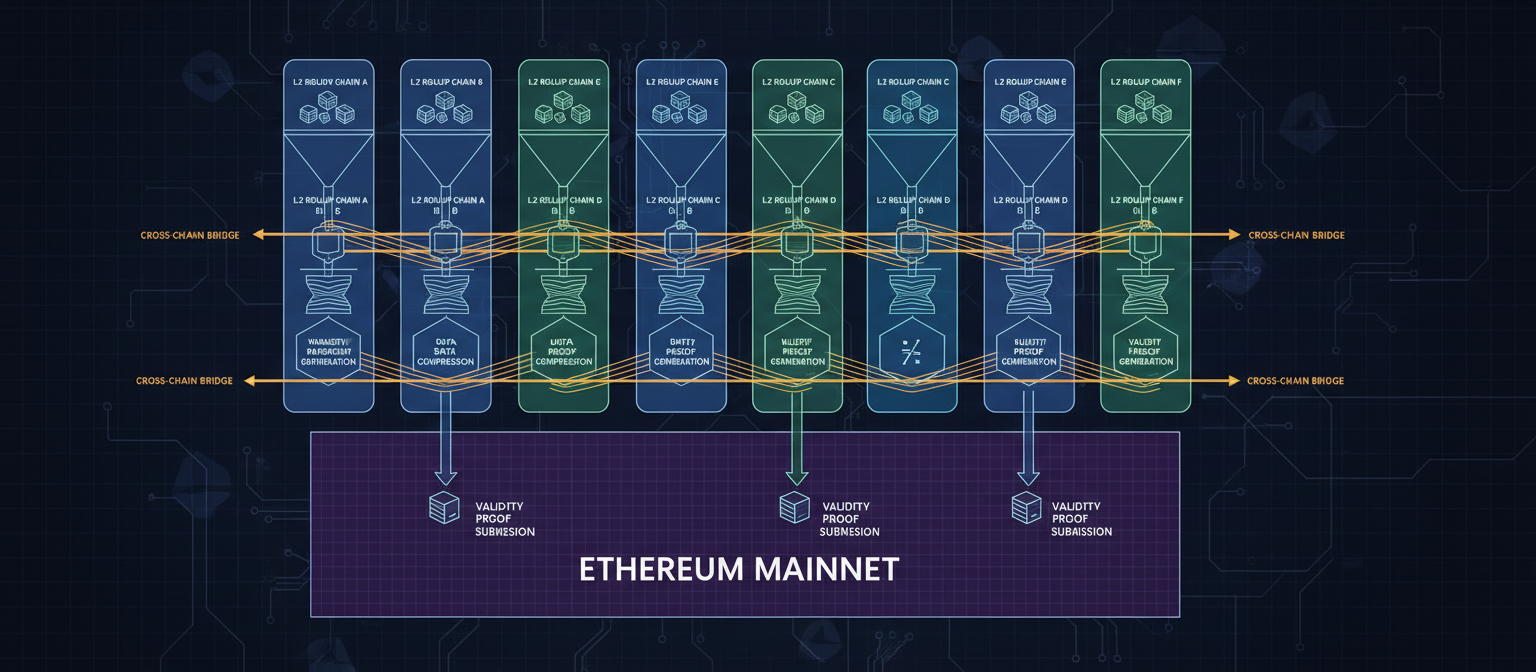
The rollup-centric approach represents Ethereum’s strategic choice to scale through modular architecture rather than monolithic blockchain design. Rollups work by executing transactions off the main Ethereum chain while posting compressed transaction data and cryptographic proofs back to L1 for security and finality.
This architecture allows rollups to process transactions much faster and cheaper than the base layer while inheriting Ethereum’s security guarantees. Optimistic rollups like Arbitrum and Optimism assume transactions are valid by default and use fraud proofs to challenge invalid transactions, while zero-knowledge (ZK) rollups like zkSync and StarkNet use validity proofs to cryptographically verify transaction correctness.
Buterin’s roadmap focuses on supporting both rollup types while improving the underlying infrastructure that enables them to scale. Key technical initiatives include introducing the Ethereum Object Format (EOF) for more efficient bytecode execution, exploring cost-optimized gas fee structures, and advancing data availability sampling techniques that allow nodes to verify data without downloading entire blocks.
The plan also emphasizes developing better data compression methods to maximize how much transaction data can be posted to L1 within existing bandwidth constraints. By compressing transaction data more efficiently, rollups can include more transactions in each batch they submit to mainnet, directly increasing throughput capacity.
Why Not Just Increase Gas Limits?
A common suggestion for scaling Ethereum involves simply raising the gas limit—the maximum amount of computational work allowed in each block. If blocks can hold more transactions, the reasoning goes, throughput automatically increases. However, Buterin explicitly rejects this approach as inconsistent with Ethereum’s decentralization goals.
Increasing gas limits would require validators to process more transactions and store more state data, directly raising the hardware requirements for running nodes. Higher hardware costs inevitably lead to fewer people being able to afford running validators, concentrating network control among well-funded entities with expensive infrastructure.
“We want to avoid simply increasing the gas limit, which would centralize the network,” Buterin emphasized in his roadmap post. This stance reflects Ethereum’s philosophical commitment to accessibility—the idea that ordinary users should be able to verify the network’s integrity by running nodes on consumer-grade hardware.
The rollup-centric approach solves this dilemma by keeping L1 requirements modest while enabling unlimited scaling through L2s. Since rollups only post compressed data and proofs to mainnet rather than every individual transaction, they can process vastly more transactions without proportionally increasing the burden on Ethereum validators.
This architecture creates a sustainable path to massive scale: as more rollups launch and existing ones optimize, total ecosystem throughput can grow indefinitely while L1 remains accessible to individual operators. The tradeoff is complexity—users must navigate multiple L2 environments rather than interacting solely with a single monolithic chain.
Cross-Chain Interoperability Challenges
One of the most significant hurdles to achieving the 100K TPS vision while maintaining good user experience is the fragmentation created by multiple independent L2 solutions. Buterin candidly addressed this issue, noting that “Ethereum should feel like one ecosystem, not 34 different blockchains.”
The current L2 landscape requires users to manually bridge assets between different rollups, each with its own interface, token standards, and user experience quirks. This fragmentation creates confusion and friction, particularly for mainstream users unfamiliar with blockchain architecture. Buterin illustrated the problem with a personal anecdote about losing $100 on Polymarket by accidentally selecting the wrong chain.
The roadmap proposes several solutions to improve cross-L2 interoperability. One key initiative involves adding standardized chain identifiers to addresses, allowing wallets to automatically recognize which network an address belongs to and route transactions appropriately. This would eliminate common user errors where funds are sent to correct addresses on wrong networks.
Enhanced cross-chain standards and protocols would enable more seamless asset transfers between L2s without forcing users to understand the underlying technical complexity. Ideally, moving funds between rollups should feel as simple as sending a regular transaction, with wallet software handling the bridging mechanics automatically in the background.
Buterin also suggested developing better tooling for multi-chain application deployment, allowing decentralized applications to operate consistently across multiple L2s. This would reduce the current situation where popular protocols must maintain separate deployments on each rollup, fragmenting liquidity and user bases.
Solving these interoperability challenges is essential for the 100K TPS vision to deliver actual user benefit. Raw throughput means little if users struggle to navigate between the various platforms providing that capacity. The roadmap recognizes that technical scaling and user experience improvements must advance together.
What This Means for Ethereum’s Future
Buterin’s roadmap represents Ethereum’s clearest articulation yet of how it plans to compete with newer blockchains advertising superior speed and lower costs. Rather than abandoning its decentralization principles to match competitors’ transaction throughput, Ethereum is doubling down on a modular architecture that aims to provide both scalability and security.
The 100,000 TPS target, if achieved, would position Ethereum’s ecosystem capacity well above what most applications require. For context, Visa’s payment network processes around 1,700 transactions per second on average, with capacity for roughly 65,000 TPS at peak. An Ethereum ecosystem capable of 100K TPS would have headroom to support global-scale applications across finance, gaming, social media, and other use cases.
However, the roadmap also acknowledges significant work remains to be done. Achieving the technical targets requires coordinated development across multiple teams building different pieces of the scaling puzzle—from core protocol developers improving L1 infrastructure to rollup teams optimizing their platforms to application developers adapting to multi-chain architecture.
The emphasis on interoperability and unified user experience suggests Ethereum’s leadership recognizes that technical capability alone doesn’t guarantee adoption. Users ultimately care about whether they can accomplish their goals easily and cheaply, not about the underlying architecture enabling those capabilities.
For investors and developers watching the ongoing “Layer 1 wars,” Buterin’s announcement signals Ethereum’s confidence in its chosen scaling path. While competitors pursue monolithic designs that trade decentralization for speed, Ethereum is betting that modular, rollup-centric architecture can deliver both—if the ecosystem can successfully coordinate around shared standards and interoperability.
The coming months will test whether this vision translates into measurable progress toward the 100K TPS goal and improved user experiences across the Ethereum ecosystem.
This article reflects the scaling roadmap as presented by Vitalik Buterin on October 17, 2024. The Surge phase remains under active development with timelines subject to change.