Ethereum is at a critical juncture as diverging narratives between crypto-native bulls and traditional Wall Street analysts create uncertainty about the cryptocurrency’s near-term trajectory. While discussion of an AI-driven “supercycle” gains traction in crypto circles, institutional skepticism persists despite remarkable quarterly performance.
Remarkable Q3 Performance
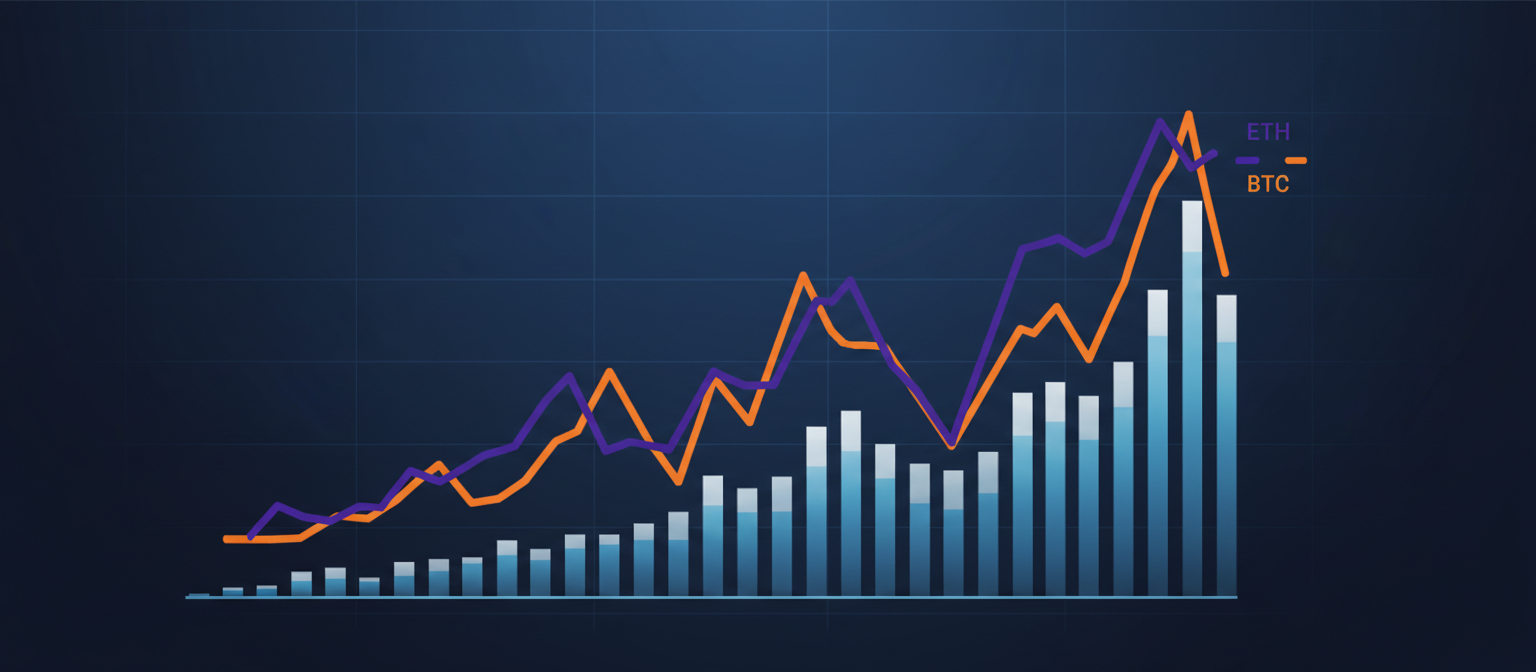
Ethereum has delivered impressive gains in the third quarter of 2025, climbing 75% against Bitcoin and outperforming many major cryptocurrencies. This strong performance has been fueled by growing institutional adoption and excitement about artificial intelligence integration, particularly following recent announcements from the Ethereum Foundation about forming a dedicated AI research team.
The institutional momentum is reflected in ETF data, with US spot ETH ETFs seeing their net assets under management more than double from $10.32 billion in June to $27.48 billion by September. This substantial institutional accumulation suggests growing confidence among traditional financial players in Ethereum’s long-term prospects.
The Supercycle Thesis
Crypto bulls, particularly major holders like BitMine (the largest corporate holder of Ether), are promoting the idea of an Ethereum “supercycle” that could challenge the traditional four-year crypto market cycles. This thesis is built on several key factors:
First, the increasing involvement of Wall Street in blockchain technology is seen as a fundamental driver that could sustain Ethereum’s growth beyond typical market cycles. The approval and launch of spot Ethereum ETFs have opened the door to a much broader investor base, potentially creating sustained demand.
Second, the convergence of AI and blockchain technologies represents what many believe could be a transformative catalyst. Recent announcements from Google about AI agent payment protocols and the Ethereum Foundation’s AI initiatives suggest Ethereum could become the primary settlement layer for the emerging AI economy.
Third, ongoing technical improvements, including the upcoming Fusaka upgrade in December, continue to enhance Ethereum’s scalability and efficiency, potentially making it more attractive for both developers and institutional users.
Wall Street’s Cautious Stance
Despite the bullish sentiment in crypto circles, traditional financial institutions remain cautious. Citigroup, for instance, has set a conservative year-end price target of $4,300 for Ethereum, reflecting skepticism about the sustainability of current price levels.
This caution stems from several concerns. Some analysts worry that the current rally may be overextended, particularly given the divergence between institutional and retail participation. Others question whether the AI integration thesis will translate into meaningful near-term value creation for Ethereum holders.
Additionally, regulatory uncertainty continues to weigh on traditional financial institutions’ enthusiasm, despite recent progress in approving crypto investment products.
Critical Technical Levels
From a technical perspective, Ethereum is currently facing a crucial test at the $4,580 resistance level. This price point represents a key psychological and technical barrier that must be overcome for ETH to maintain its bullish momentum and potentially reach the $5,000 target that many analysts have set for year-end.
The ability to reclaim and hold above $4,580 could trigger further buying pressure and potentially set the stage for a run at the psychologically important $5,000 level. Conversely, failure to break through this resistance could lead to a period of consolidation or even a pullback.
Retail vs. Institutional Dynamics
One of the most interesting aspects of the current market environment is the divergence between institutional and retail participation. While institutional investors have been aggressively accumulating Ethereum through ETFs and other investment vehicles, retail activity has been notably weak.
This divergence is evident in exchange data, which shows negative net taker volume on platforms like Binance, suggesting that retail traders are selling more Ethereum than they’re buying. This institutional-retail divergence could be a double-edged sword for Ethereum’s price prospects.
On one hand, institutional accumulation provides a strong foundation for price stability and potential appreciation. On the other hand, the lack of retail participation could limit the explosive growth potential that has characterized previous crypto bull markets.
ETF Inflows and Market Impact
The growth of Ethereum ETFs has been a major driver of institutional demand this year. These investment products have made it significantly easier for traditional investors to gain exposure to Ethereum without dealing with the complexities of directly holding cryptocurrencies.
The rapid increase in ETF assets under management demonstrates strong institutional appetite for Ethereum exposure. This institutional adoption is particularly significant because it represents a more stable and sustainable source of demand compared to the retail-driven speculative flows that have historically dominated crypto markets.
AI Integration as a Catalyst
The growing intersection of artificial intelligence and blockchain technology represents what could be a transformative catalyst for Ethereum. Recent announcements about AI agent payment protocols and the formation of AI research teams suggest that Ethereum could play a central role in the emerging AI economy.
If these AI integration initiatives prove successful, they could open up entirely new use cases for Ethereum and drive significant demand for ETH as the primary settlement layer for AI applications. This could fundamentally alter Ethereum’s value proposition and support higher valuation multiples over the long term.

Regulatory Landscape
The regulatory environment continues to evolve, with recent developments generally positive for cryptocurrency adoption but still creating uncertainty for traditional financial institutions. The approval of spot Ethereum ETFs represented a significant milestone, but broader regulatory clarity is still needed.
Ongoing discussions about cryptocurrency regulation, stablecoin oversight, and DeFi protocols could all impact Ethereum’s trajectory in the coming months. Positive regulatory developments could accelerate institutional adoption, while adverse regulatory actions could dampen enthusiasm.
What to Watch in Coming Months
Several key factors will likely determine Ethereum’s price trajectory in the final months of 2025:
The ability to break through the $4,580 resistance level will be crucial for maintaining bullish momentum. Strong performance above this level could trigger additional institutional inflows and potentially attract renewed retail interest.
The success of AI integration initiatives and their impact on Ethereum’s utility will be closely watched. Concrete developments in AI agent adoption and decentralized AI infrastructure could provide meaningful catalysts.
The upcoming Fusaka upgrade in December will be another important event to monitor. Successful implementation of this technical improvement could demonstrate Ethereum’s continued evolution and enhance its long-term value proposition.
Investment Implications
For investors, the current environment presents both opportunities and challenges. The strong institutional support and promising AI integration thesis provide compelling reasons for optimism about Ethereum’s long-term prospects.
However, the cautious stance from Wall Street and technical resistance levels suggest that investors should be prepared for potential volatility. The divergence between institutional and retail participation also creates uncertainty about near-term price dynamics.
Those with a long-term investment horizon may find the current institutional accumulation and AI integration initiatives particularly compelling, while shorter-term traders may need to navigate the technical resistance and regulatory uncertainty.
This article reflects market conditions and analysis as of September 24, 2025. Cryptocurrency markets are inherently volatile, and this analysis should not be considered investment advice.