
As Ethereum continues to grapple with persistent scalability challenges, Polygon’s revolutionary Zero Knowledge Ethereum Virtual Machine (zkEVM) technology is emerging as a potential game-changer for the blockchain ecosystem. The layer-2 scaling solution promises to dramatically increase transaction throughput while maintaining the security and decentralization that make Ethereum the leading smart contract platform.
Polygon’s zkEVM represents a significant leap forward in blockchain scaling technology, combining zero-knowledge cryptographic proofs with full Ethereum Virtual Machine compatibility. This innovative approach could finally resolve the tension between scalability, security, and decentralization that has plagued the blockchain industry for years.
Understanding Ethereum’s Scalability Bottleneck
Ethereum’s current architecture can process approximately 15 transactions per second, a limitation that becomes particularly problematic during periods of high network congestion. This throughput constraint results in exorbitant gas fees and slow transaction times, hindering mainstream adoption and limiting the platform’s ability to support large-scale decentralized applications.
The problem stems from Ethereum’s proof-of-work consensus mechanism and its requirement that every network node validate and execute every transaction. As network usage grows, this linear scaling model creates increasing bottlenecks, driving up costs and reducing accessibility for users and developers.
Traditional scaling solutions have often sacrificed one of blockchain’s core tenets—decentralization or security—in pursuit of improved performance. Polygon’s zkEVM aims to break this trade-off by leveraging advanced cryptographic techniques to scale without compromising on Ethereum’s fundamental values.
How Polygon’s zkEVM Technology Works
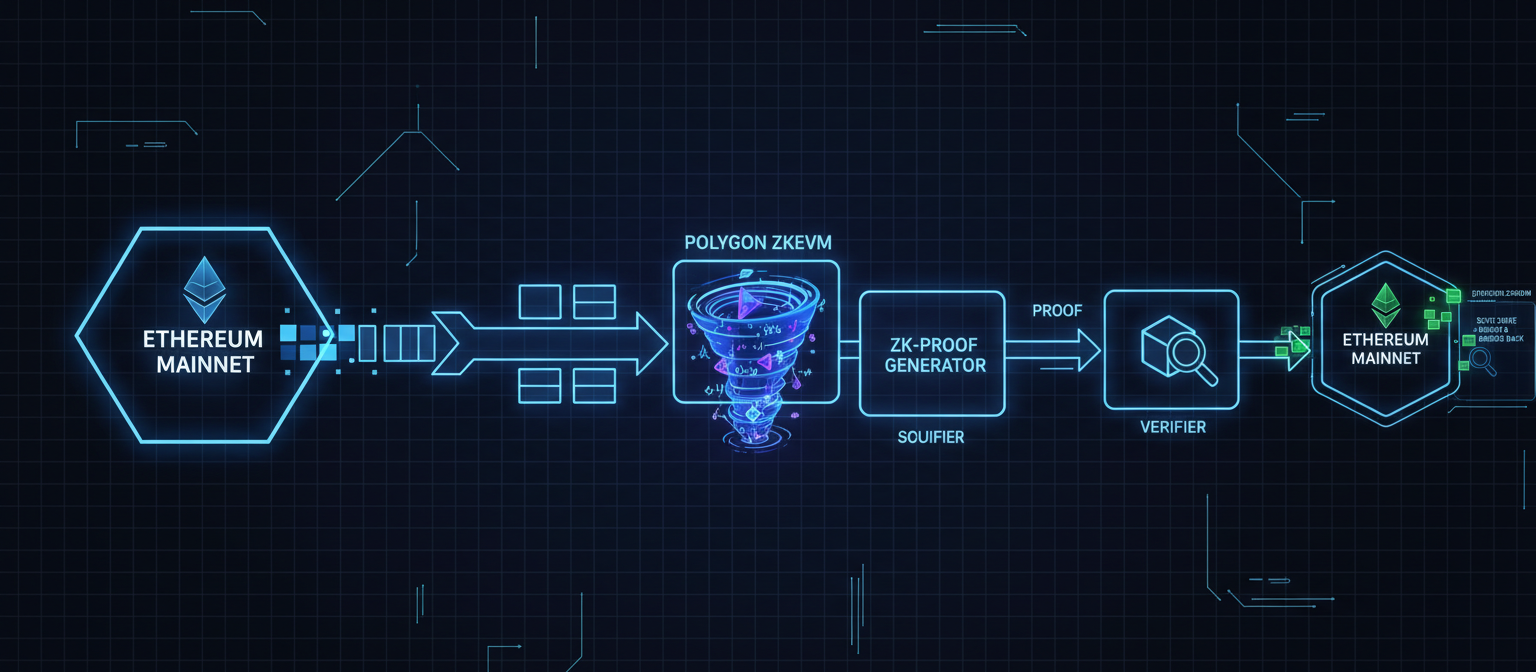
At its core, Polygon’s zkEVM utilizes zero-knowledge proofs (ZKPs)—a cryptographic method that allows one party to prove to another that a statement is true without revealing any underlying information. This technology enables Polygon to validate transactions off-chain while posting compressed cryptographic proofs back to Ethereum’s mainnet for final settlement.
The process works by bundling hundreds or thousands of transactions together, executing them off-chain, and then generating a single cryptographic proof that verifies the validity of all transactions in the batch. This proof is then submitted to Ethereum’s mainnet, where it can be verified quickly and cheaply, achieving massive scalability improvements while inheriting Ethereum’s security guarantees.
What makes Polygon’s approach particularly revolutionary is its full compatibility with existing Ethereum smart contracts and developer tools. Unlike some scaling solutions that require developers to learn new programming languages or rewrite existing applications, Polygon’s zkEVM allows seamless migration of existing Ethereum applications without code modifications.
The Competitive Landscape: Polygon vs. Other Scaling Solutions
Polygon’s zkEVM enters a crowded field of Ethereum scaling solutions, each with different approaches to the scalability challenge. Optimistic rollups like Arbitrum and Optimism use fraud proofs to validate transactions, while alternative ZK-rollup solutions like StarkNet require different programming languages.
Polygon’s key differentiator lies in its combination of ZK-rollup technology with full EVM compatibility. This means developers can use familiar tools like Solidity, Hardhat, and Truffle to build applications that benefit from ZK-rollup scalability without learning new frameworks or programming languages.
The technology also benefits from Polygon’s existing ecosystem advantages. With years of development experience, a mature developer community, and partnerships with major brands like Disney, Nike, and Mastercard, Polygon offers more than just technical innovation—it provides an established platform with proven track record and growing adoption.
Real-World Applications and Use Cases
The implications of Polygon’s zkEVM technology extend far beyond simple transaction processing. The platform enables complex decentralized applications that were previously impractical due to Ethereum’s limitations:
DeFi Applications: Decentralized finance protocols can offer significantly lower fees and faster transaction times, making yield farming, lending, and borrowing accessible to a broader range of users.
Gaming and NFTs: Blockchain-based games and NFT marketplaces can support high-frequency transactions and complex interactions without prohibitive costs, enabling new gaming mechanics and digital asset experiences.
Enterprise Solutions: Businesses can leverage Polygon’s scalability for supply chain management, identity verification, and asset tokenization while maintaining integration with Ethereum’s extensive ecosystem.
Cross-Chain Interoperability: Polygon’s technology facilitates seamless asset transfers and interactions between different blockchain networks, helping to create a more interconnected decentralized economy.
Challenges and Considerations
Despite its promising technology, Polygon’s zkEVM faces several challenges on its path to widespread adoption. The technology is still relatively new, and questions remain about its long-term security properties and performance under various network conditions.
Centralization concerns also persist, as Polygon’s validator set remains relatively limited compared to Ethereum’s extensive network of nodes. Critics argue that this could create potential vulnerabilities or points of failure that compromise the network’s decentralization.
Additionally, the broader cryptocurrency market’s volatility and regulatory uncertainty could impact adoption rates and development timelines. As with all blockchain technologies, success will depend not just on technical merit but also on market dynamics, regulatory clarity, and community support.
The Future of Ethereum Scaling
Polygon’s zkEVM represents a significant step forward in the evolution of blockchain scaling technology. Rather than attempting to replace Ethereum, the solution enhances and extends Ethereum’s capabilities, creating a complementary ecosystem that preserves Ethereum’s core values while addressing its limitations.
The coming months will be crucial for determining zkEVM’s impact on the broader blockchain ecosystem. As more developers migrate applications to the platform and users experience the benefits of lower fees and faster transactions, Polygon’s approach could establish a new paradigm for blockchain scaling.
For Ethereum users and developers, Polygon’s zkEVM offers a glimpse of a future where blockchain applications can achieve mainstream adoption without sacrificing the principles of decentralization and security that make cryptocurrency technology revolutionary. Whether this vision becomes reality remains to be seen, but the potential for transforming the blockchain landscape is undeniable.
This article reflects information available as of February 1, 2025. Technology developments and market conditions may have evolved since publication.