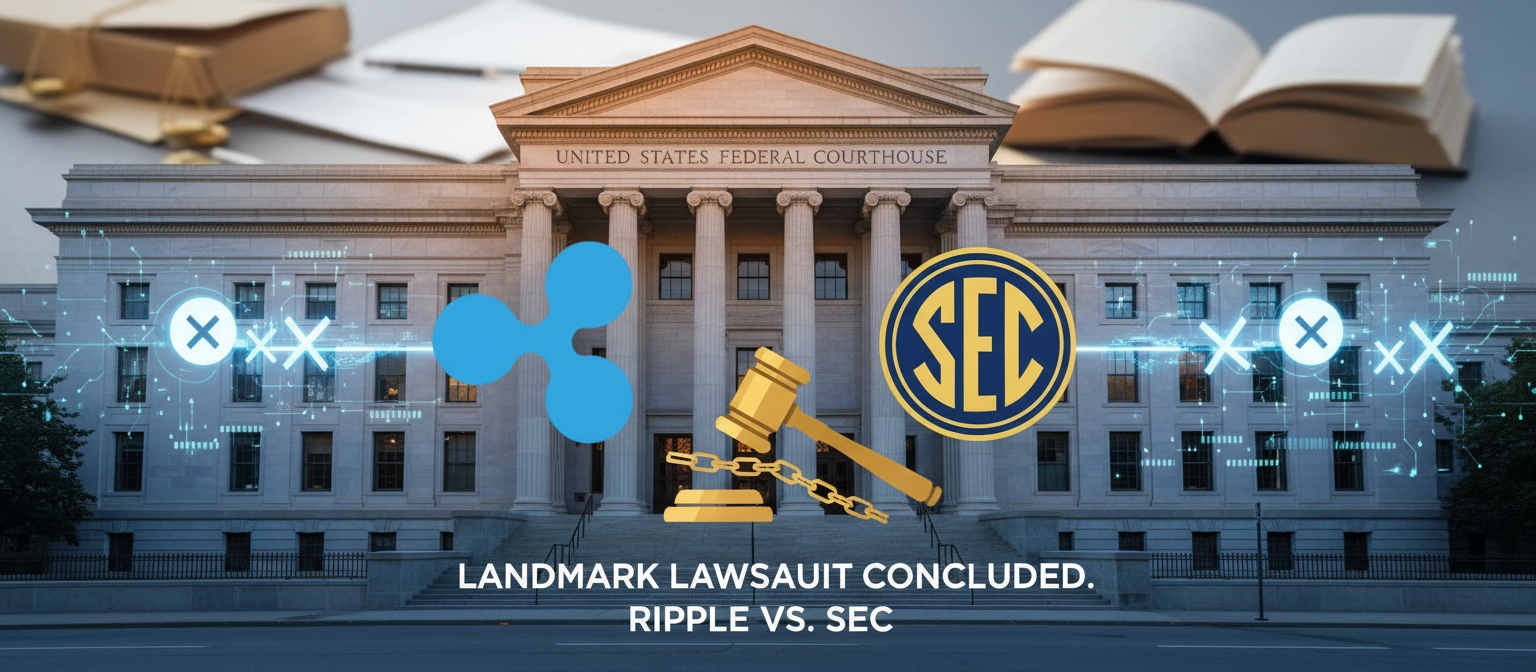
After more than four years of contentious litigation that became one of the most closely watched legal battles in cryptocurrency history, the SEC and Ripple Labs jointly filed to dismiss their appeals today, officially bringing the landmark XRP case to a close. The August 7 filing in the Second Circuit Court marks the definitive end to a lawsuit that has shaped regulatory thinking around digital assets and left a precedent that could influence crypto regulation for years to come.
The Final Chapter
The joint stipulation of dismissal, filed this morning, formally ends both parties’ appeals of District Judge Analisa Torres’ July 2023 ruling. Under the agreement, each party will bear its own costs and legal fees—a practical conclusion to a case that has consumed enormous resources on both sides and captivated the entire cryptocurrency industry.
This decision leaves Judge Torres’ original ruling intact: XRP sales on secondary markets and through trading algorithms do not constitute securities offerings, while Ripple’s institutional sales did violate securities law. The company was ordered to pay $125 million in civil penalties and permanently enjoined from further violations—penalties that now stand as the final word in this dispute.
Why Now?
The timing of this resolution is no accident. The case had been in limbo since earlier this year when both parties agreed to pause their appeals following significant leadership changes at the SEC. The Trump administration’s return to the White House brought a wholesale shift in the agency’s approach to cryptocurrency enforcement, with the SEC dropping over a dozen crypto-related cases and investigations in recent months.
For Ripple, the decision to drop its cross-appeal represents a calculated choice: accept a $125 million penalty in exchange for preserving a landmark judicial finding that XRP itself is not a security when sold on secondary markets. For the SEC, withdrawing its appeal signals a recognition that continued litigation—especially under new leadership skeptical of aggressive crypto enforcement—was unlikely to yield a better outcome.
What the Ruling Means
Judge Torres’ decision, now the final word on this matter, established several critical precedents:
The Howey Test Applied to Digital Assets: The court found that the manner and circumstances of a token’s sale—not the token itself—determine whether it’s a security. XRP traded on exchanges and purchased by retail investors didn’t meet the Howey Test’s investment contract criteria.
Institutional vs. Retail Sales: The ruling drew a clear line between programmatic sales to retail investors (not securities) and direct sales to institutional investors with the expectation of profit from Ripple’s efforts (securities). This distinction could guide how other crypto projects structure their token distributions.
Regulatory Clarity Through Litigation: While not the regulatory framework the industry hoped for, this case provides concrete judicial interpretation of how existing securities law applies to digital assets—something the crypto sector has desperately sought.
Market Impact and Industry Implications

XRP’s price jumped approximately 7% on the news, reflecting market optimism about the resolution. Beyond immediate price action, the implications are broader:
XRP ETF Pathway: With the legal cloud lifted and a court ruling affirming XRP’s non-security status in secondary markets, the path toward a potential XRP exchange-traded fund becomes significantly clearer. Several asset managers had been waiting for this legal certainty before proceeding with XRP ETF applications.
Regulatory Precedent: Other cryptocurrency projects facing SEC scrutiny now have a judicial benchmark to reference. The Torres ruling’s framework for distinguishing securities from non-securities based on distribution methods provides a roadmap—albeit an imperfect one—for compliance.
Enforcement Priorities: The SEC’s decision to drop this appeal, combined with its broader pullback from crypto enforcement, suggests a fundamental recalibration of how the agency will approach digital asset regulation going forward.
Industry Reactions
Ripple CEO Brad Garlinghouse celebrated the outcome on social media, calling it “a monumental victory for Ripple, the XRP community, and the entire crypto industry in the U.S.” Legal experts noted that while the case resolves a specific dispute, it highlights the urgent need for comprehensive legislation rather than regulation through enforcement.
Stuart Alderoty, Ripple’s Chief Legal Officer, emphasized that “this case will be studied in law schools for years to come” and argued it demonstrates why clear rules from Congress are essential for the industry’s future.
What Comes Next
With the Ripple case resolved, attention now turns to how this precedent will influence other pending SEC actions and whether Congress will finally pass legislation providing comprehensive regulatory clarity for digital assets. The ruling doesn’t solve all questions—debates over what constitutes sufficient decentralization, how DeFi protocols should be classified, and whether certain staking mechanisms constitute securities all remain unresolved.
For Ripple and XRP, however, today marks the beginning of a new chapter: one focused on growth and adoption rather than litigation and uncertainty. The company can now pursue partnerships, expand its cross-border payment solutions, and potentially see XRP included in traditional financial products without the shadow of an unresolved SEC lawsuit.
The crypto industry as a whole gains something equally valuable: proof that even in the uncertain regulatory landscape of digital assets, it’s possible to challenge enforcement actions and establish precedent through the courts. Whether that’s enough to provide the clarity the industry needs remains to be seen, but today’s resolution is undeniably a milestone worth recognizing.