
Russia is set to officially legalize cryptocurrency mining starting tomorrow, November 1, 2024, marking a dramatic policy shift that positions the country as one of the first major powers to embrace regulated digital asset mining. President Vladimir Putin signed the landmark legislation in August, and the law’s implementation comes as Russia faces mounting economic pressure from Western sanctions and seeks alternative mechanisms for international trade and capital flows.
The new regulatory framework requires miners to register with government authorities, establishes geographic restrictions based on energy availability, and explicitly positions cryptocurrency as a tool for cross-border payments. The move represents a calculated bet that Bitcoin and other digital assets can help Russia circumvent financial isolation while creating economic opportunities in energy-rich regions facing underutilized power generation capacity.
The Regulatory Framework: Control Through Legalization
Russia’s approach to crypto mining legalization differs significantly from the hands-off regulatory stance taken by many Western nations. Rather than simply permitting mining activity, the Russian government has constructed a comprehensive framework that maintains significant state control over the industry while providing legal clarity for participants.
Under the new law, only Russian legal entities and individual entrepreneurs registered with government authorities can engage in commercial-scale cryptocurrency mining. The Ministry of Digital Development sets the conditions miners must meet to obtain registration, while the Federal Tax Service maintains the official miner registry. Foreign entities are explicitly prohibited from conducting mining operations within Russian territory.
Individual miners can participate without formal registration, but only if their electricity consumption remains within government-established limits. This provision allows small-scale hobbyist mining while ensuring that significant operations come under state oversight. All registered miners must declare their mined digital assets to authorized government bodies, creating transparency that enables taxation and regulatory compliance monitoring.
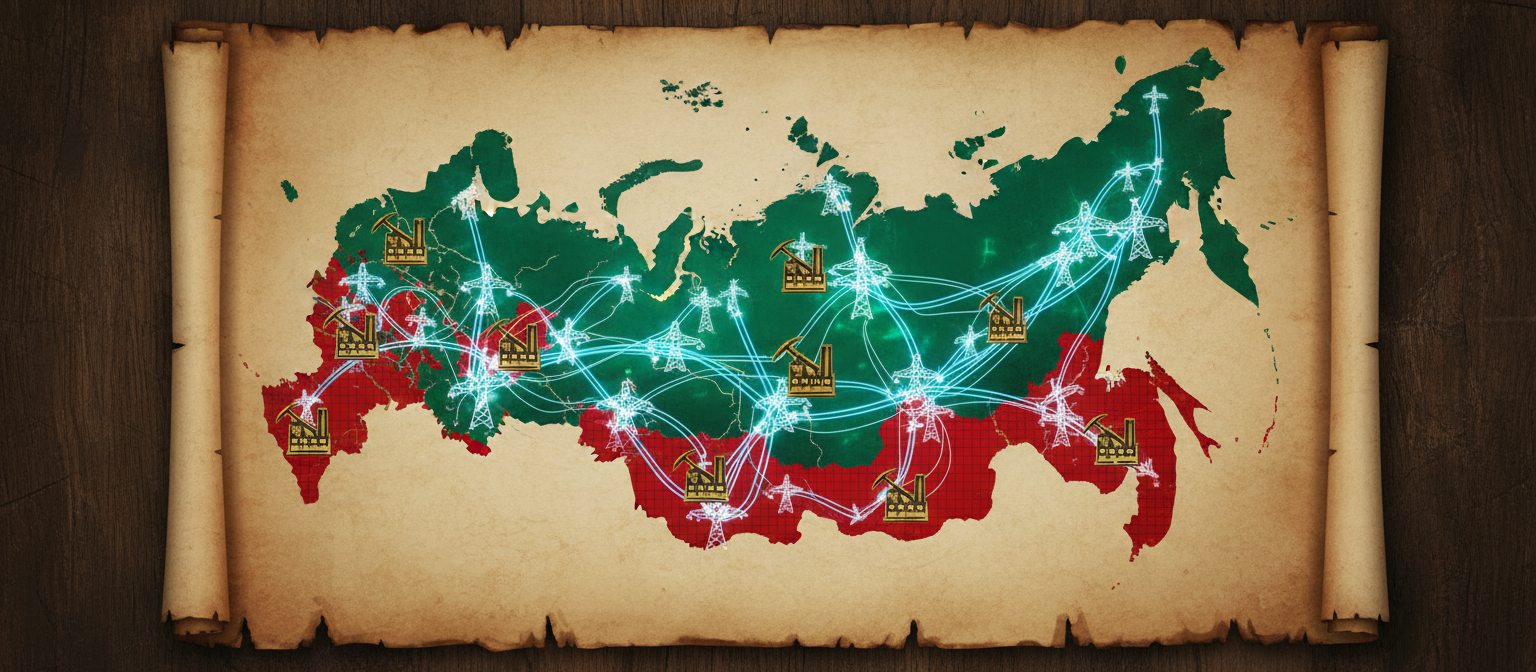
The law grants authorities power to restrict or ban mining in specific regions or territories based on energy availability and infrastructure capacity. This geographic control mechanism allows the government to direct mining activity toward areas with excess power generation while protecting regions facing electricity shortages from additional strain on their grids.
President Putin signed a second related law on October 25 that establishes taxation frameworks for cryptocurrency mining and outlines rules for using digital currencies in cross-border transactions. These provisions will take effect in March 2025, completing the regulatory infrastructure for Russia’s controlled embrace of cryptocurrency.
The Sanctions Dimension: Bitcoin as Financial Workaround
The timing and structure of Russia’s mining legalization cannot be separated from the country’s broader struggle to maintain international economic engagement under Western sanctions. Since the 2022 invasion of Ukraine, Russia has faced unprecedented financial restrictions that have complicated international trade and isolated Russian entities from global banking systems.
Anton Gorelkin, deputy head of the State Duma committee on information policy, stated explicitly that Russian authorities view cryptocurrencies “primarily as a tool for circumventing sanctions.” This frank acknowledgment reveals the strategic calculation behind the mining legislation—cryptocurrency represents a potential mechanism for conducting international commerce outside the Western-controlled financial infrastructure.
Russia’s cross-border cryptocurrency payment framework, which became operational in September 2024 under earlier legislation, allows businesses to use Bitcoin and other digital assets for international transactions. Energy companies have reportedly begun using Bitcoin and Tether for oil exports to countries including China, India, and Turkey, bypassing traditional banking channels and dollar-denominated transactions that would be vulnerable to sanctions enforcement.
The mining legalization complements this cross-border payment capability by ensuring Russia can domestically produce significant quantities of Bitcoin rather than relying solely on purchasing it through exchanges. Mining operations convert Russia’s abundant energy resources directly into a borderless digital asset that can facilitate international trade, effectively transforming electricity into a sanctions-resistant export commodity.
Western policymakers and sanctions enforcement officials are monitoring these developments closely. The effectiveness of financial sanctions depends partly on limiting sanctioned entities’ access to alternative payment mechanisms. Russia’s systematic development of cryptocurrency infrastructure represents the most significant state-level effort to build sanctions circumvention capabilities using digital assets.
Energy Economics: Converting Stranded Power into Digital Assets
Beyond sanctions considerations, Russia’s mining legalization reflects pragmatic energy economics. The country possesses vast electricity generation capacity, particularly in Siberian regions far from major population and industrial centers. Transporting this power to distant markets involves transmission losses and infrastructure costs that can make remote generation economically marginal.
Cryptocurrency mining offers an alternative use case for this stranded energy. Mining operations can locate directly adjacent to power generation facilities, consuming electricity that would otherwise go unused or require expensive long-distance transmission. The resulting Bitcoin can be transferred anywhere globally at minimal cost, effectively making energy portable in ways that physical electricity cannot be.
Russian electricity costs in mining-favorable regions range from approximately 5 to 5.3 rubles per kilowatt-hour, translating to roughly 5-6 cents per kWh at current exchange rates. These power costs compare favorably to mining economics in many other jurisdictions, particularly as Bitcoin’s price has appreciated and mining profitability has improved throughout 2024.
Siberia, with its cold climate, hydroelectric resources, and sparse population, presents particularly attractive conditions for large-scale mining. The region’s naturally low temperatures reduce cooling costs for mining equipment, while abundant hydroelectric generation provides relatively clean and inexpensive power. These geographic advantages position Russia to potentially capture significant global hashrate share if regulatory stability attracts sufficient investment.
The government’s ability to restrict mining in energy-deficit regions while directing it toward areas with surplus capacity demonstrates an interventionist approach to industrial policy. Rather than allowing market forces alone to determine mining location, authorities are using regulatory tools to align mining development with broader energy infrastructure priorities.
Industry Response and Investment Implications
Russian and international mining companies have monitored the regulatory development closely, with many waiting for legal clarity before committing significant capital to operations within the country. The law’s implementation tomorrow provides that clarity, potentially unlocking investment in mining infrastructure and associated industries.
Several challenges remain for companies considering Russian mining operations. International firms face not only the explicit legal prohibition on foreign mining entities but also broader complications related to sanctions compliance, payment processing, and operational risks associated with Russia’s geopolitical situation. Western mining companies and their financial partners must navigate potential sanctions violations if they directly or indirectly support Russian mining operations.
Russian domestic firms face fewer legal obstacles but must navigate the registration requirements and government oversight that come with the new framework. The centralized registry system and mandatory asset declarations create transparency that cuts both ways—providing legal protection for compliant operators while giving authorities comprehensive visibility into industry participants and their activities.
The upcoming taxation framework, set to take effect in March 2025 under the October 25 law, will significantly impact mining profitability. While details remain to be fully implemented, the existence of clear tax treatment represents a major improvement over previous regulatory ambiguity. Miners can plan operations with confidence that the legal and tax environment will remain stable rather than facing potential retroactive penalties or arbitrary enforcement.
Global Hashrate Implications and Competitive Dynamics
Russia’s formal entry into regulated cryptocurrency mining could meaningfully impact global hashrate distribution and competitive dynamics in the Bitcoin mining industry. The country’s combination of low electricity costs, abundant power generation capacity, and now-clear legal framework positions it to potentially capture significant mining market share.
Bitcoin mining has become increasingly concentrated in several key jurisdictions following China’s 2021 mining ban, which displaced massive hashrate that subsequently relocated primarily to the United States, Kazakhstan, and Canada. The United States currently hosts over 35% of global Bitcoin mining capacity, making it the dominant single jurisdiction for the industry.
Russia’s mining industry already existed in informal and semi-legal status before tomorrow’s legalization, with estimates suggesting the country may host 10-15% of global hashrate through unregistered operations. The new legal framework could enable significant expansion beyond this baseline as both domestic and foreign capital (navigating the restrictions) seek to capitalize on Russia’s energy advantages.
The geopolitical implications of Russia potentially becoming a major mining center extend beyond immediate hashrate statistics. Bitcoin mining’s geographic distribution affects the network’s resilience to jurisdiction-specific regulations or infrastructure disruptions. Concentration in any single country or geopolitical bloc creates potential vulnerabilities, while broader distribution enhances network robustness.
Regional Restrictions and Energy Infrastructure Reality
While the law legalizes mining nationally, it simultaneously establishes significant geographic restrictions that will shape industry development. Authorities have identified 10 regions where mining will be restricted or prohibited starting tomorrow due to electricity infrastructure constraints and shortage concerns.
The restricted regions include Dagestan, Ingushetia, Kabardino-Balkaria, Karachay-Cherkessia, North Ossetia, Chechnya, as well as the contested Donetsk, Lugansk, Zaporizhzhia, and Kherson regions that Russia claims following the Ukraine conflict. Deputy Energy Minister Yevgeny Grabchak has indicated that additional restrictions may apply to parts of the Far East, southwestern Siberia, and southern Russia where electricity deficits exist or large new capacity cannot be provided until 2030.
These geographic restrictions reflect genuine infrastructure constraints rather than arbitrary limitations. Russia’s electricity grid, like that of many large countries, faces regional imbalances between generation capacity and demand. Areas experiencing electricity shortages or inadequate transmission infrastructure cannot support energy-intensive mining operations without risking disruptions to residential and commercial power supplies.
The restrictions also reveal political calculations. Several of the listed regions are majority-Muslim areas of the North Caucasus where Moscow maintains careful control over economic development and security concerns. The newly claimed Ukrainian territories face infrastructure damage from ongoing conflict and uncertain long-term status. Prohibiting mining in these sensitive regions may reflect desires to avoid economic complications in politically complex areas.
For the mining industry, these restrictions create a clearer picture of where investment can productively deploy. Companies can focus on Siberian regions and other areas with confirmed power availability rather than attempting operations in locations where regulatory approval will be unlikely or electricity access uncertain.
International Reactions and Regulatory Implications
Western governments and international financial institutions are monitoring Russia’s cryptocurrency mining legalization with concern about its potential to undermine sanctions effectiveness. The U.S. Treasury Department and European Union sanctions enforcement bodies have already identified cryptocurrency as a potential sanctions evasion vector, and Russia’s formalization of mining and cross-border crypto payments validates these concerns.
The development may prompt additional regulatory responses from Western nations seeking to maintain sanctions integrity. Potential measures could include enhanced monitoring of cryptocurrency transactions involving Russian counterparties, restrictions on Western mining companies providing equipment or services to Russian operations, or secondary sanctions targeting entities facilitating Russia’s crypto-based trade.
Other countries facing international sanctions or seeking to reduce dependence on Western financial systems are observing Russia’s approach carefully. Iran, Venezuela, and North Korea have all explored cryptocurrency as potential mechanisms for economic engagement despite sanctions, though none have implemented frameworks as comprehensive as Russia’s emerging system. If Russia successfully uses regulated mining and crypto payments to maintain trade relationships, other sanctioned nations may attempt similar strategies.
The mining industry globally faces questions about how to respond to Russia’s legalization. Equipment manufacturers, mining pool operators, and cryptocurrency exchanges must navigate compliance obligations while determining whether and how they can interact with Russian mining entities without violating sanctions. The decentralized nature of Bitcoin mining complicates enforcement—Russian miners can potentially access global mining pools and sell Bitcoin through exchanges that may have limited visibility into the ultimate identity of participants.
Looking Ahead: Implementation and Uncertainty
Tomorrow’s implementation of Russia’s mining legislation begins a period of practical application that will reveal how the regulatory framework functions in practice. Key questions remain about registration processes, enforcement approaches, taxation specifics, and the government’s operational interpretation of the various provisions.
The broader success of Russia’s controlled legalization approach depends significantly on maintaining political and economic stability that allows long-term mining investment. The capital-intensive nature of modern Bitcoin mining requires multi-year planning horizons and confidence in regulatory continuity. Political risks, sanctions complications, and Russia’s ongoing international isolation create uncertainty that may deter some potential investors despite favorable energy economics.
For the global cryptocurrency industry, Russia’s move represents a significant moment in Bitcoin’s evolution from a purely decentralized, ideology-driven project to an asset that major nation-states actively integrate into economic and geopolitical strategies. The tension between Bitcoin’s original vision of censorship-resistant, permissionless money and its emerging role in state-level sanctions evasion and financial strategy represents a fundamental development worth monitoring.
As November 1 arrives tomorrow, Russia joins a small group of countries that have moved beyond regulatory ambiguity to establish clear legal frameworks for cryptocurrency mining. Whether this framework proves successful in attracting investment, supporting sanctions circumvention, and productively deploying Russia’s energy resources will become clear over the coming months and years. For now, the legislation represents the most significant cryptocurrency regulatory development of 2024 and a case study in how nation-states are beginning to strategically engage with digital assets.
This article reflects market conditions and information available as of October 31, 2024.