
Private sector stablecoins are dramatically outpacing central bank digital currencies in the global race to transform money, with the stablecoin market reaching $234 billion in April 2025 while government CBDC initiatives face mounting setbacks and public resistance. The divergence represents a significant victory for cryptocurrency innovation over state-controlled digital money, potentially reshaping the future of global finance for decades to come.
The stark contrast between thriving private stablecoins and struggling government projects has become increasingly apparent in recent months. While stablecoin issuers like Circle and Tether continue expanding their market presence and exploring yield-bearing products, central banks from South Korea to the United States are halting or scaling back CBDC development programs. The trend suggests that private sector innovation, not government initiative, may ultimately define the future of digital money.
Treasury Report Highlights Stablecoin Dominance
A landmark Treasury Department report presented April 30 underscores the dramatic shift toward stablecoin adoption and the challenges facing CBDC alternatives. The document reveals that stablecoins have evolved from simple cryptocurrency trading tools to sophisticated payment mechanisms that could fundamentally reshape traditional banking. Treasury analysts project the stablecoin market could reach $2 trillion by 2028, representing explosive growth that would challenge conventional financial structures.
The Treasury report identifies several key factors driving stablecoin dominance over CBDCs. First, stablecoins combine the efficiency and technological advantages of blockchain with the stability that users expect from traditional currencies. Second, private sector innovation has proven more agile and responsive to market demands than government-led initiatives. Third, stablecoin issuers are increasingly offering yield-bearing products that compete directly with traditional savings accounts and money market funds.
Perhaps most significantly, the Treasury analysis highlights how stablecoins are beginning to converge with money market funds, creating hybrid financial products that challenge the traditional banking system’s dominance over payment services and savings vehicles. This convergence could accelerate the displacement of traditional banks as stablecoin providers offer competitive interest rates and enhanced digital services.
Global CBDC Retreat Accelerates
April 2025 has witnessed a remarkable retreat from CBDC initiatives across multiple major economies. South Korea’s central bank officially halted its retail CBDC project, citing resistance from commercial banks and technical implementation challenges. The decision represents a significant setback for CBDC proponents, as South Korea was considered one of the most technologically advanced economies likely to successfully implement a digital currency.
The United States Congress is considering legislation that would explicitly prevent the Federal Reserve from issuing a CBDC, reflecting growing political opposition to government-controlled digital money. The proposed legislation stems from concerns that a U.S. CBDC could mirror China’s e-CNY system, potentially enabling government surveillance and control over private financial transactions.
Brazil and Russia, while continuing to explore digital currency options for international trade, are increasingly relying on private stablecoins rather than government-issued alternatives. Both countries have implemented regulatory frameworks that facilitate cryptocurrency use while their central banks slow-roll CBDC development. The approach suggests that even nations seeking to bypass traditional financial systems are finding private stablecoins more practical than government alternatives.
Innovation Advantage Drives Private Sector Success
The divergence between stablecoins and CBDCs reflects fundamental differences in innovation capacity and market responsiveness. Private sector stablecoin developers have proven far more agile than government agencies, rapidly iterating products, responding to user feedback, and incorporating cutting-edge technology. This innovation gap has become increasingly apparent as stablecoins add sophisticated features like yield generation, programmable payments, and integration with decentralized finance protocols.
Andrew MacKenzie, CEO of digital infrastructure firm Agant, notes that the private sector’s innovation advantage stems from competitive pressure and profit incentives that government agencies lack. “Stablecoin issuers must constantly improve their products to attract and retain users,” MacKenzie explains. “Central banks face no such competitive pressure, which naturally leads to slower innovation and less user-focused development.”
The innovation disparity is particularly evident in user experience and functionality. Modern stablecoins offer features like instant settlement, global accessibility, programmable payments, and integration with digital wallets and financial applications. CBDC prototypes, by contrast, often struggle with basic functionality and limited interoperability with existing financial systems.
Regulatory Clarity Boosts Stablecoin Adoption
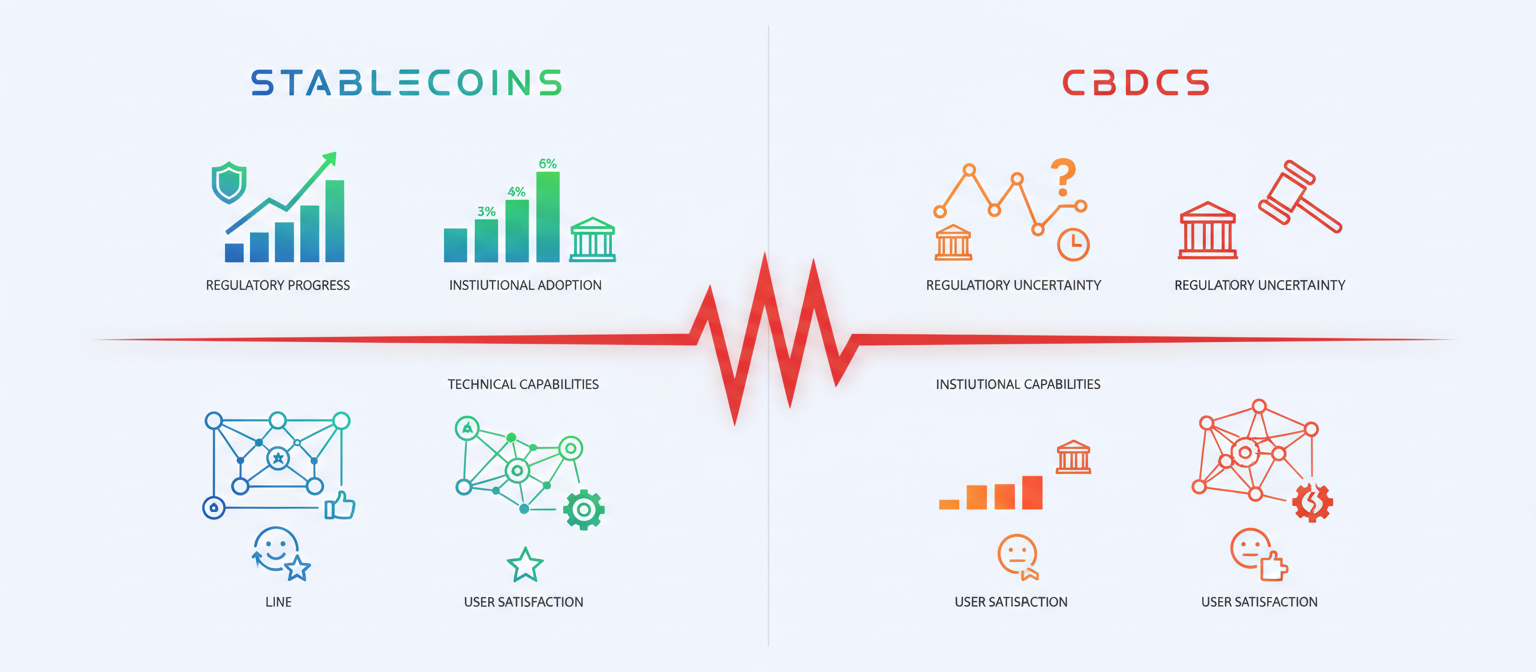
Regulatory developments in the United States and European Union have provided crucial clarity that has accelerated stablecoin adoption while constraining CBDC alternatives. The proposed GENIUS Act in Congress would establish clear requirements for dollar-backed stablecoins, potentially increasing institutional adoption and consumer confidence. Similarly, the EU’s MiCA regulation has created a comprehensive framework for stablecoin operations that provides legal certainty for issuers and users.
These regulatory frameworks contrast sharply with the uncertain future facing CBDCs. While stablecoin issuers now operate under relatively clear rules and requirements, CBDC projects remain mired in political controversy and technical uncertainty. The regulatory advantage has made stablecoins increasingly attractive to financial institutions and businesses seeking reliable digital payment solutions.
Treasury officials have noted that clear regulation enables stablecoin issuers to access traditional banking services, form partnerships with established financial institutions, and attract institutional investment. These advantages create a virtuous cycle where regulatory clarity leads to increased adoption, which in turn drives further investment and innovation.
Market Structure Implications
The ascendance of stablecoins over CBDCs carries profound implications for the structure of global financial markets. Perhaps most significantly, stablecoins could redirect substantial liquidity away from traditional bank deposits into dollar-denominated digital assets. The Treasury report suggests this shift could increase demand for U.S. Treasury securities while potentially forcing banks to raise interest rates to remain competitive.
The competitive pressure from yield-bearing stablecoins represents a particular challenge to traditional banks. As stablecoin providers offer competitive interest rates with superior digital interfaces and global accessibility, banks may struggle to retain deposits, especially among younger, tech-savvy customers. The pressure could accelerate banking sector consolidation while forcing surviving institutions to invest heavily in digital transformation.
The stablecoin advantage extends beyond retail banking to institutional finance. Corporations are increasingly using stablecoins for international payments and treasury management, attracted by their efficiency, low cost, and regulatory compliance. This institutional adoption creates network effects that further strengthen stablecoins’ position relative to both traditional banking and CBDC alternatives.
International Trade and Geopolitics
Stablecoins are also gaining ground in international trade, particularly among countries seeking alternatives to traditional financial systems. Brazil and Russia have implemented regulations allowing cryptocurrency use for cross-border settlements, providing a blueprint for other nations seeking to bypass sanctions or reduce reliance on dollar-dominated payment networks.
The trend has significant geopolitical implications, potentially reducing the effectiveness of financial sanctions while creating new pathways for international commerce. Countries facing sanctions or seeking to diversify away from traditional financial systems find stablecoins particularly attractive due to their global accessibility and relative independence from government control.
However, the growing use of stablecoins in international trade also raises compliance challenges. Regulatory authorities are increasingly concerned about money laundering, terrorist financing, and sanctions evasion through stablecoin networks. These concerns could lead to stricter regulation of stablecoin issuers and increased monitoring of stablecoin transactions.
Future Outlook and Challenges
Looking forward, the competition between stablecoins and CBDCs appears increasingly settled in favor of private sector solutions. While central banks may continue developing wholesale CBDCs for interbank settlements, retail CBDCs face diminishing political support and technical momentum. The trend suggests that private stablecoins will likely become the dominant form of digital currency for everyday transactions and international commerce.
However, significant challenges remain for stablecoin adoption. Regulatory uncertainty persists in many jurisdictions, and concerns about financial stability continue to trouble policymakers. The inability of stablecoin issuers to access Federal Reserve master accounts could create volatility during market stress, potentially requiring government intervention to prevent systemic disruptions.
Despite these challenges, the momentum behind private stablecoins appears unstoppable. The combination of innovation capacity, regulatory clarity, and market adoption creates powerful advantages that government CBDCs cannot easily match. The outcome represents a fundamental victory for cryptocurrency proponents who have long argued that private sector innovation, not government initiative, should drive the future of money.
This article reflects digital currency market conditions and regulatory developments as of April 15, 2025.