
Hut 8, one of North America’s largest Bitcoin mining companies, announced today a major partnership with President Donald Trump’s sons to launch American Bitcoin, a new mining subsidiary targeting 50 exahash per second capacity. The announcement comes on the final day of Bitcoin’s worst first quarter since 2018, with the cryptocurrency down 11.7 percent amid ongoing tariff policy uncertainty that has rattled financial markets.
The timing of the Trump family’s entry into Bitcoin mining is notable. While the cryptocurrency struggles through a challenging quarter—falling from January’s all-time high of 109,000 dollars to today’s 82,000 dollar range—the mining venture represents a long-term bullish bet on Bitcoin’s infrastructure layer at prices substantially below recent peaks.
American Bitcoin will operate as an 80 percent owned subsidiary of publicly traded Hut 8, with the remaining 20 percent held by Eric Trump, Donald Trump Jr., and early investors in the original Trump-led data center firm. The deal structure gives Hut 8 majority control while aligning the Trump family’s interests with the company’s ambitious expansion plans.
The American Bitcoin Structure
Under the partnership announced today, Hut 8 contributed substantially all of its Bitcoin mining ASICs—specialized computer chips designed specifically for Bitcoin mining—to the new subsidiary in exchange for its 80 percent equity stake. The arrangement allows Hut 8 to maintain operational control while leveraging the Trump family’s brand recognition and political connections to accelerate growth.
Eric Trump will serve as Chief Strategy Officer of American Bitcoin, with Matt Prusak—Hut 8’s former Chief Commercial Officer—taking the CEO role. Mike Ho serves as Executive Chairman, leading a board that includes Asher Genoot, Justin Mateen, and Michael Broukhim.
The company has set ambitious technical targets: achieving 50-plus exahash per second of mining capacity with average fleet efficiency below 15 joules per terahash. For context, the global Bitcoin network currently operates at approximately 600 exahash per second, meaning American Bitcoin’s goal would represent roughly 8 percent of total network hash rate—a substantial share that would make it one of the world’s largest mining operations.

Hut 8 will provide exclusive ASIC colocation and managed services to American Bitcoin under commercial agreements announced today. This arrangement creates a vertically integrated structure where Hut 8 handles day-to-day mining operations and infrastructure while American Bitcoin focuses on strategic growth and capital deployment.
The company plans to pursue a public listing, though today’s announcement did not specify a timeline. A successful IPO would make American Bitcoin the first Trump family business venture to trade on public markets, creating a unique intersection of cryptocurrency, politics, and traditional finance.
The Trump Family’s Bitcoin Evolution
The launch of American Bitcoin marks a significant evolution in the Trump family’s relationship with cryptocurrency. President Trump famously dismissed Bitcoin as a “scam” during his first term, expressing skepticism about digital assets that competed with the U.S. dollar’s reserve currency status.
That stance shifted dramatically during the 2024 presidential campaign. Trump embraced cryptocurrency as a campaign issue, speaking at the Bitcoin 2024 conference in Nashville and making explicit promises to the industry: establishing a federal Strategic Bitcoin Reserve, eliminating capital gains taxes on cryptocurrency transactions, firing SEC Chairman Gary Gensler, and creating a regulatory environment conducive to digital asset innovation.
The campaign pivot reflected political calculation—cryptocurrency had become a salient issue for a meaningful voting bloc, particularly younger and tech-oriented voters in swing states. But it also reflected influence from Trump’s sons, who had developed genuine interest in cryptocurrency and convinced their father that digital assets represented an important economic and technological frontier.
Donald Trump Jr. described the mining opportunity in characteristically direct terms: “Mining Bitcoin on favorable economics opens an even bigger opportunity.” The quote reflects the family’s view that Bitcoin mining—while capital intensive and operationally complex—offers attractive unit economics for operators who can secure cheap electricity and efficient hardware.
Eric Trump positioned the venture in strategic terms: “It is a great honor to partner with Hut 8. We are poised to strengthen our foundation and drive significant future growth.” The emphasis on partnership and growth suggests the Trump family views this as more than a licensing deal—it’s a genuine operational venture where family members will play active roles in strategy and development.
The mining venture adds to a broader Trump family cryptocurrency portfolio. The family previously launched NFT collections that generated millions in revenue, though those projects drew criticism as cash grabs trading on the Trump name rather than offering genuine utility. American Bitcoin represents a more substantial, infrastructure-focused commitment to the cryptocurrency sector.
Bitcoin’s Challenging First Quarter
The American Bitcoin announcement comes as the cryptocurrency closes one of its most difficult quarters in recent history. Bitcoin fell 11.7 percent in Q1 2025, marking its worst first-quarter performance since 2018 and ranking as the 12th weakest quarter out of the past 15 first quarters.
The decline represents a sharp reversal from the optimism that characterized late 2024 and early 2025. Bitcoin surged following Trump’s November election victory, breaking through 100,000 dollars in December and reaching an all-time high of 109,000 dollars on January 20—President Trump’s inauguration day. The rally reflected expectations that the new administration’s pro-cryptocurrency stance would drive institutional adoption and regulatory clarity.
Those hopes collided with tariff policy reality in February. President Trump’s announcement of 25 percent tariffs on Canadian and Mexican imports, along with 10 percent tariffs on Chinese goods, triggered risk-off sentiment across financial markets. Bitcoin, which advocates argue should serve as an uncorrelated alternative asset, instead traded closely with equities—falling sharply as investors retreated from growth-oriented and speculative investments.
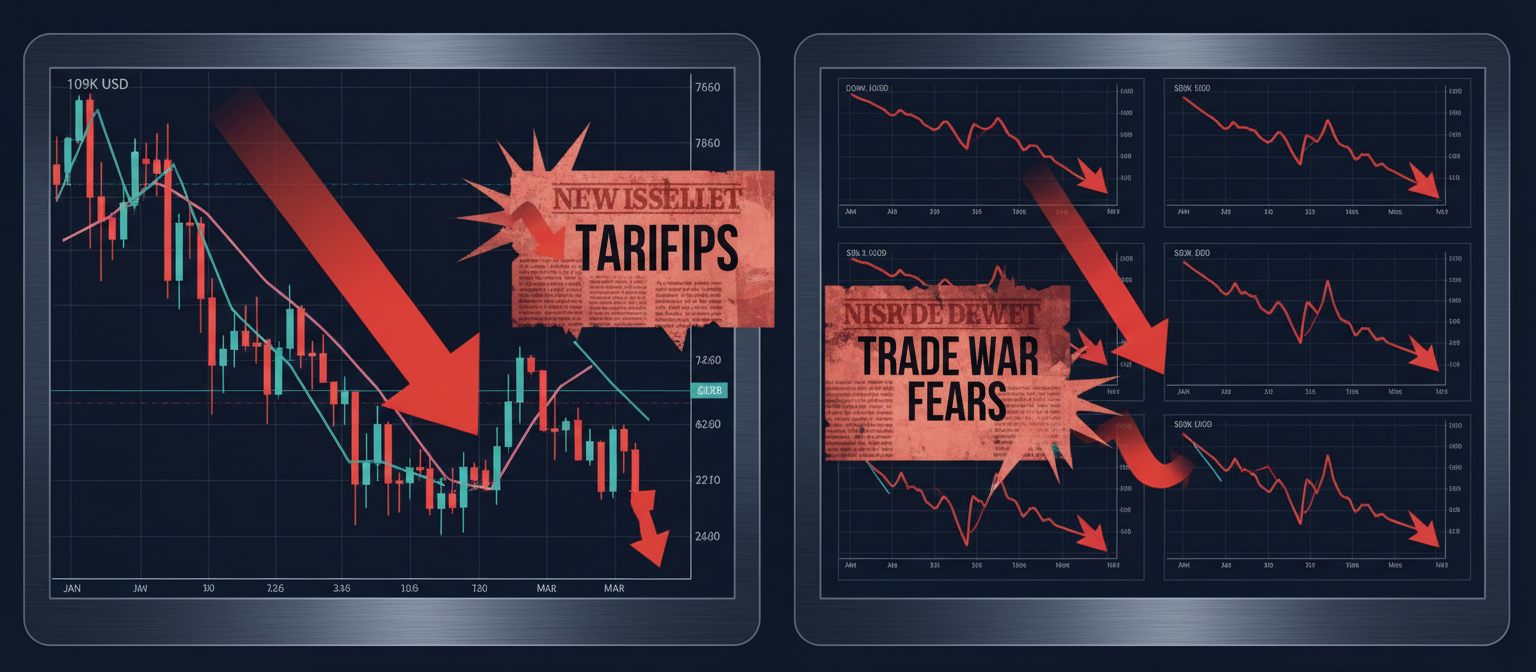
The tariff-driven selloff intensified through February and March, with Bitcoin breaking through multiple support levels that traders had identified as likely to hold. The cryptocurrency fell below 100,000 dollars, then 90,000, then 85,000, ultimately settling into the low 80,000 dollar range where it trades today as March closes.
March also saw market manipulation concerns, with analysis identifying spoofing activity—large fake buy or sell orders designed to move prices—that prevented Bitcoin from sustaining rallies above 87,500 dollars. The spoofing, attributed to one or more large holders, contributed to the choppy, range-bound trading that has frustrated both bulls and bears.
Tariff Uncertainty and Risk-Off Sentiment
The fundamental driver of Bitcoin’s Q1 weakness has been macroeconomic uncertainty stemming from Trump administration tariff policies. What began as targeted tariffs on specific trading partners has evolved into a broader trade policy overhaul that investors fear could trigger inflation, slow economic growth, or both—a stagflationary scenario particularly hostile to risk assets.
The economic concern extends beyond Bitcoin to traditional markets. The S&P 500 and Nasdaq have posted significant declines since the tariff announcements, with some analysts raising recession odds as trade policy uncertainty clouds the growth outlook. In this environment, Bitcoin has traded as a risk-on asset—correlated with equities rather than serving as a safe haven like gold.
That correlation has disappointed Bitcoin advocates who argue the cryptocurrency should provide diversification benefits during traditional market stress. The Q1 experience suggests that when systemic uncertainty rises and risk appetite collapses, investors sell Bitcoin alongside stocks rather than rotating into digital assets as a hedge. Whether this correlation persists long-term or represents a temporary dynamic specific to tariff-driven uncertainty remains an open question.
Despite the challenging price action, some market structure indicators suggest underlying strength. Whale accumulation—large holders adding to positions—has increased during the Q1 decline, with major Bitcoin holders rising 2.6 percent in five weeks according to on-chain data. The accumulation suggests sophisticated investors view current prices as attractive entry points, even as broader markets remain cautious.
The Mining Investment Thesis
The Trump family’s decision to launch a Bitcoin mining venture during a quarter of significant price weakness reflects a distinct investment thesis from simply buying and holding cryptocurrency. Mining is an infrastructure play—a bet that Bitcoin will maintain and grow its network over time, generating fee revenue and block subsidies for operators who can mine efficiently.
Several factors make mining attractive even when Bitcoin prices decline from recent highs. First, mining profitability depends not just on Bitcoin’s absolute price but on the relationship between price, network difficulty, and electricity costs. As Bitcoin’s price falls, some miners shut down unprofitable operations, reducing network difficulty and improving margins for efficient operators who remain online.
Second, mining offers a form of cost averaging. Rather than purchasing Bitcoin at a single price point, miners effectively acquire Bitcoin at their production cost, which averages out over time. If Bitcoin eventually recovers and appreciates, miners benefit from having accumulated coins during a down market at favorable effective prices.
Third, the Trump family’s timing—entering mining near the end of a challenging quarter—potentially positions American Bitcoin to deploy capital and scale operations ahead of a recovery. If Bitcoin rebounds in the coming quarters, American Bitcoin could be bringing significant new capacity online just as mining economics improve.
The 50-plus exahash target represents massive scale. Achieving that capacity would require substantial capital investment in both mining hardware and energy infrastructure. The company will need to secure cheap, reliable electricity—typically the largest ongoing expense for miners—and acquire or manufacture cutting-edge ASICs capable of meeting the below-15 joules per terahash efficiency target.
The Political Dimension
The American Bitcoin announcement carries obvious political dimensions that extend beyond typical corporate mining ventures. President Trump’s sons are now directly financially interested in Bitcoin mining success, creating potential conflicts of interest around regulatory and energy policy decisions that affect the mining sector.
Bitcoin mining has become a politically salient issue in recent years, with debates over energy consumption, environmental impact, and appropriate regulatory treatment. Some jurisdictions have banned or restricted mining; others have actively courted it as economic development. Federal policy decisions on issues like renewable energy credits, electricity grid access, and cryptocurrency taxation all materially impact mining economics.
With the Trump family now operating a mining business, those policy decisions take on additional complexity. Will American Bitcoin receive favorable treatment from Trump administration agencies? Will critics view any pro-mining policy decisions as cronyism benefiting the President’s family? The optics create potential complications for both the company and the administration.
Hut 8 Executive Chairman Mike Ho addressed the partnership in aspirational terms: “The launch of American Bitcoin marks a pivotal evolution in our platform strategy.” The careful language reflects awareness that this is no ordinary mining deal—it’s a partnership that will face scrutiny both from cryptocurrency enthusiasts hoping for policy support and critics concerned about conflicts of interest.
Looking Ahead: Q2 and Beyond
As March closes with Bitcoin hovering around 82,000 dollars—down nearly 25 percent from the January all-time high—the cryptocurrency enters Q2 with significant uncertainty about near-term direction. The tariff policies that have weighed on risk assets remain in effect, though markets may gradually adjust to the new trade policy reality if no further escalation occurs.
Several potential catalysts could drive Q2 price action in either direction. Resolution of trade policy uncertainty—whether through accommodation with trading partners or confirmation that current tariff levels represent the new baseline—could reduce the risk-off sentiment that has pressured Bitcoin. Alternatively, further trade conflict escalation could drive additional selling.
Bitcoin ETF flows will also be critical. Spot Bitcoin ETFs have experienced periods of both heavy inflows and outflows during Q1’s volatile conditions. A return to sustained institutional buying through ETFs could provide the demand necessary to push Bitcoin back above key technical levels. Conversely, continued institutional selling would suggest more downside ahead.
For American Bitcoin, the coming quarters will focus on operational execution: deploying capital to acquire mining hardware, securing energy contracts, building out infrastructure, and beginning to scale toward the 50 exahash target. The company will need to demonstrate that its mining economics work—that it can produce Bitcoin efficiently and profitably even in challenging market conditions.
The Trump family’s entry into Bitcoin mining represents a significant moment regardless of how the broader market performs. It signals conviction that Bitcoin’s infrastructure layer offers attractive long-term opportunities, provides high-profile validation of mining as a legitimate business, and creates new intersections between cryptocurrency, traditional finance, and U.S. politics.
Whether American Bitcoin achieves its ambitious targets will depend on execution, capital deployment, and Bitcoin’s price trajectory over the coming years. But today’s announcement makes clear that the Trump family views Bitcoin mining as more than campaign rhetoric—it’s now a major business venture backed by partnership with an established public company and specific technical and financial goals.
As Bitcoin closes its worst quarter in seven years, the cryptocurrency faces a critical test of whether its long-term value proposition can withstand short-term macroeconomic challenges. The American Bitcoin launch suggests at least one prominent family is betting that Bitcoin’s future remains bright, even if the present moment feels uncertain.
This article reflects market conditions and developments as of March 31, 2025.